
If you buy cosmetic or personal-care ingredients, the troublesome errors are usually mundane: the quote names one grade, the TDS names another, or the sample cannot be tied to the proposed commercial manufacturer and site. The price can look right while the supply option is wrong.
This checklist is for cosmetic brands, formulators, contract manufacturers and procurement teams. The aim is simple: keep the material's identity intact from the first requirement and supplier conversation through the specification, sample, quotation, order and delivered batch. The controls will vary with the ingredient, intended use and destination market.
The comparison only works when every supplier answers the same written requirement. Product name, chemical form, grade, specification, documents, packaging, quantity, destination and release expectations all need to describe the same supply option. A polished COA or a familiar CAS number cannot repair a mismatch between them.
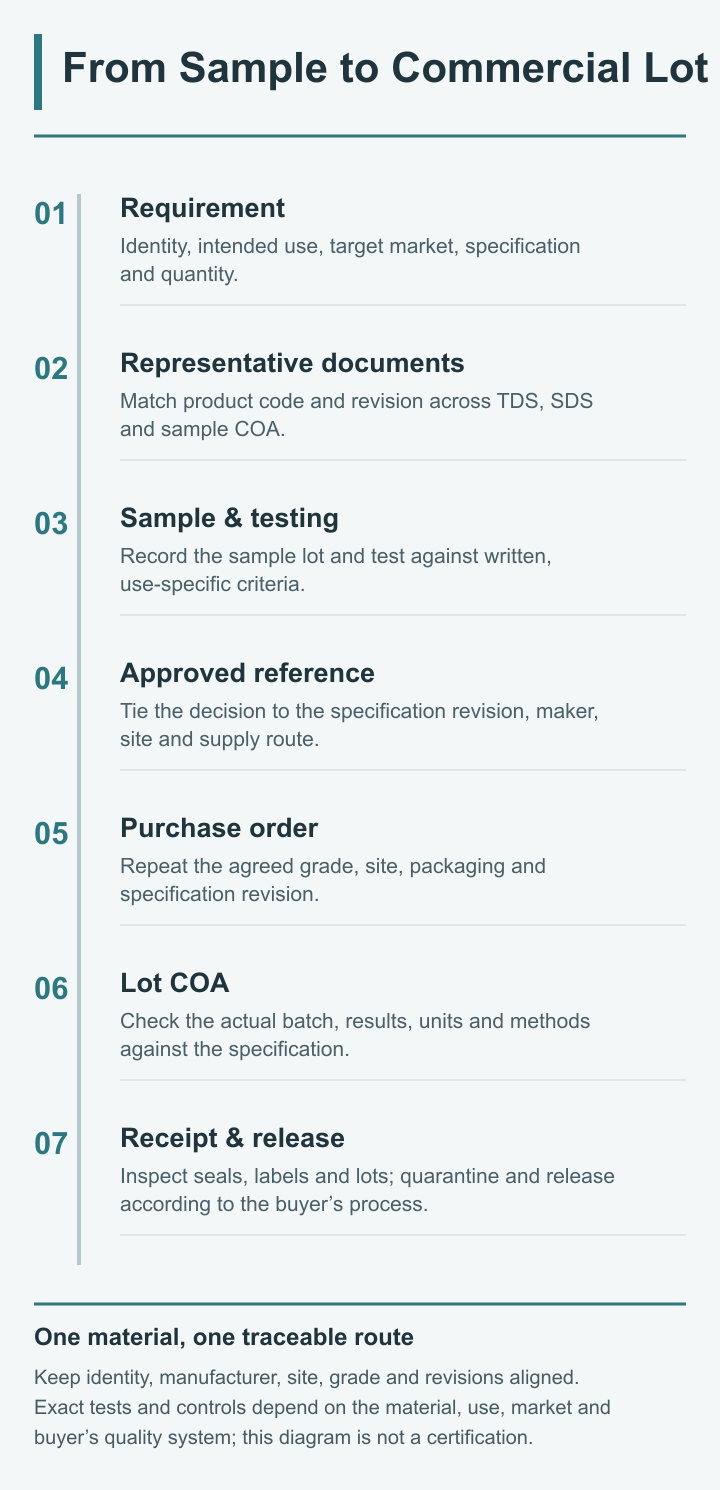
1. Start with the use and destination market
Start with what the material has to do and where the finished product will be sold. “Need vitamin C” or “looking for a preservative” leaves too much open. State the application, product type, target market and the formulation or process constraints that matter.
A cosmetic ingredient, food additive and pharmaceutical intermediate can share a chemical name while requiring different grades and controls. A supplier can provide raw-material information; it cannot decide the finished product's legal category or assume the brand's responsibilities.
For cosmetic projects, Derreva's cosmetic ingredient sourcing page leads into the relevant catalog and request process.
2. Pin down the identity, form and grade
Write every known identifier, then ask the supplier to confirm how they relate:
- common chemical name and accepted synonym;
- INCI name, where applicable;
- CAS or EC number;
- trade name and manufacturer product code;
- salt, hydrate, isomer or other chemical form;
- concentration, carrier or dilution;
- intended grade and application.
A trade name may cover a blend. The same INCI name can appear on materials with different carriers or active contents. A CAS number may identify the substance while leaving the grade, assay basis and impurity limits unresolved.
The European Commission's CosIng database is useful for nomenclature and references, but the Commission warns that an INCI name appearing there does not mean the ingredient is approved for cosmetic use. Check the applicable law for the target market.
3. Write the specification the order will use
A seller's typical data is context until the buyer defines the acceptance criteria. List the properties that matter and mark each as required, preferred or informational. The list may include identity, assay, water, impurities, microbiology or particle size, but it has to follow the material and intended use.
Record units, test methods and calculation basis. “Purity 99%” is incomplete if one supplier reports on a dry basis and another as received. Agree which specification revision governs the order.
4. Identify the seller, manufacturer and site
A manufacturer, distributor or sourcing partner can each be a valid route. Ask for the legal seller, actual manufacturer, manufacturing country and site, and their relationship. Confirm who issues the specification, SDS and lot COA.
This information can remain inside the qualification file. Its job is to trace the proposed route from buyer to seller, manufacturer and site. Under the buyer's quality system, a manufacturer or site change may trigger requalification; the approved procedures and risk assessment should determine how much review and evidence that requires.
5. Read the TDS past the headline numbers
A technical data sheet usually describes the material, typical properties, handling or formulation information. Check product code, manufacturer, revision, identity, concentration and storage. Separate typical values from guaranteed limits.
Check internal consistency: Does the form match the quote? Does the trade name resolve to the same identity? A TDS provides context, while batch-release evidence belongs in the agreed lot documentation.
6. Use the SDS for the job it actually does
The safety data sheet deals with classification, hazards, first aid, handling, storage, exposure controls, transport and disposal. It sits alongside the specification and COA; it does not replace either one. Check the identifier, supplier, revision, receiving jurisdiction and language.
ECHA's guidance explains when an SDS is required under REACH. Obligations vary, so “no SDS” calls for a regulatory check rather than an automatic conclusion. A generic SDS for a similar chemical is not evidence for the offered product.
7. Do not confuse a sample COA with the lot COA
A representative COA shows the expected reporting format. The commercial COA should identify the actual batch and report release results against the agreed specification. Confirm batch number, relevant dates, results, units, methods and disposition.
Ask for the numerical result when an agreed numerical limit matters. Compare the COA with the quote and TDS; product code, manufacturer, grade and specification revision should align.
8. Tie the sample to the commercial supply route
Ask whether the sample comes from current production, retained inventory, a pilot batch or another site. Record its lot and COA. Test using an application-appropriate, risk-based protocol and retain a reference when your quality system calls for one.
A successful sample tells you about that sample. It does not speak for every future batch. Before scale-up, confirm that the commercial material follows the same identity, grade, site and specification. Derreva's ingredient sourcing and document support can keep those stages in one request thread.
9. Put every quotation on the same basis
Unit price rarely gives a like-for-like comparison. Put quantity, price basis, currency, packaging, shipping term and named place, destination, sample policy, document scope, testing expectations and payment terms in one table. State whether duties, taxes, freight, special packing and temperature controls are included or excluded.
MOQ and lead time belong to the specific supply option rather than an industry-wide benchmark. Ask what starts the quoted lead time: payment, approved specification, packaging availability or production scheduling. Record the quotation validity period and what can change the price. Mark missing fields as pending and request them from the supplier.
10. Settle packaging, storage and logistics before the PO
Confirm package material, net weight, inner liners, closure, palletization and label fields. Align shelf life or retest period with the supporting basis and required remaining life at receipt. If temperature, humidity or light matters, define the condition, monitoring expectation and response to an excursion.
Transport classification, tariff classification, import permits and destination-country restrictions require qualified review. The SDS may inform transport handling, but a seller's informal HS code suggestion is not a customs ruling. Buyers should involve their customs broker, regulatory team and logistics provider for the actual lane.
11. Put change notification in the agreement
Supply continuity depends on knowing when the material is no longer the one that was approved. Agree which changes need advance notice and may require requalification. Manufacturer or site, process route, raw-material source, chemical form, carrier, specification, test method, packaging, shelf life and regulatory status are all possible triggers.
The notice period and approval process are commercial and quality terms to negotiate; they should not be invented in a blog post. Define who receives notice, what evidence accompanies it and whether shipments can continue before buyer approval.
12. Reconcile the file at shipment and receipt
Before shipment, reconcile the purchase order, specification revision, batch quantity, package count, label, lot COA and any required shipping documents. At receipt, inspect seals and packaging, confirm lot identities and place the material into the receiving site's normal quarantine and release process.
Supplier documentation supports release; it does not transfer the buyer's finished-product responsibilities. In the United States, the FDA states that cosmetic products and ingredients generally do not require FDA premarket approval, except for color additives not intended for use as coal-tar hair dyes, and that companies marketing cosmetics remain legally responsible for safety. In the EU, the European Commission says a CosIng entry is informational and does not, by itself, determine regulatory status.
The official scope of ISO 22716:2007 is GMP guidance for the production, control, storage and shipment of cosmetic products. A supplier's reference to the standard is therefore one input, not ingredient approval or batch evidence. Where a certificate forms part of your qualification, verify its issuing body, covered organization, site and scope under your own quality procedure.
A sourcing brief every candidate can answer
Comparable replies start with the same brief. Use the text below in an email or enquiry form, replace the brackets, and remove a field only when it genuinely does not apply.
Subject: Cosmetic ingredient sourcing request — [INCI or product name] — [destination]
Project details
- Buyer/project: [brand, formulator or contract manufacturer]
- Finished product and intended use:
 View ingredient
(R)-Lipoic Acid
(R)-Lipoic Acid (CAS 1200-22-2) — specification-led B2B sourcing reference. Compare offers by exact acid form, assay or concentration,…COASDSSample support - Destination market(s): [country or region]
Material identity
- Requested name / INCI / CAS: [details]
- Trade name or manufacturer code, if specified: [details]
- Chemical form, concentration or carrier: [details]
- Required grade: [details]
Technical requirement
- Specification revision or critical limits: [attach or list]
- Test methods or reporting basis that must be used: [details]
- Sample quantity and evaluation timing: [details]
Commercial requirement
- First-order quantity and forecast, if known: [details]
- Packaging and remaining shelf life required at receipt: [details]
- Ship-to country and postal code: [details]
- Requested delivery window and Incoterm, if known: [details]
Please confirm in one reply
- Legal seller, manufacturer and manufacturing site.
- The exact product code and specification revision quoted.
- Available representative COA, TDS and applicable SDS.
- Sample source or lot, sample lead time and sample terms.
- MOQ, price basis, packaging, lead-time trigger and quotation validity.
- How manufacturer, site, specification and other material changes are notified.
Keep each reply attached to the same brief. That makes gaps visible without forcing a reviewer to reconstruct the requirement from several email threads. Add any material-specific safety, regulatory or quality questions identified by your technical teams.
You can search the ingredient catalog first, or send a structured sourcing brief when the exact listing is uncertain.
Clear up the document questions before comparing suppliers
What separates a COA, TDS and SDS? A COA reports release information for a batch or, when clearly labeled, shows a representative reporting format. A TDS describes the product's technical characteristics and use-related information. An SDS communicates hazards and safe handling. They answer different questions, but their product identities should agree.
A CAS number is rarely enough to source the material. It may identify a substance without settling chemical form, concentration, carrier, grade, assay basis, impurity profile, particle size, manufacturer or site. Add the identity and specification fields that matter to the application.
A CosIng result does not approve an ingredient for the EU. The European Commission describes CosIng as informative and non-legally binding. Regulatory status comes from the Cosmetics Regulation and its annexes, read for the actual use and alongside the finished-product safety assessment.
The sample and bulk COA do not need identical numerical results; they report different lots. They should use the agreed identity, specification, units and reporting basis. An unexplained change in product code, manufacturer, site, grade or method deserves investigation before the bulk route is accepted.
The strongest sourcing file is not the one with the most attachments. It is the one where every attachment traces back to the same approved material and commercial route. That makes price comparisons clearer, change discussions faster and surprises at receiving much easier to contain.