
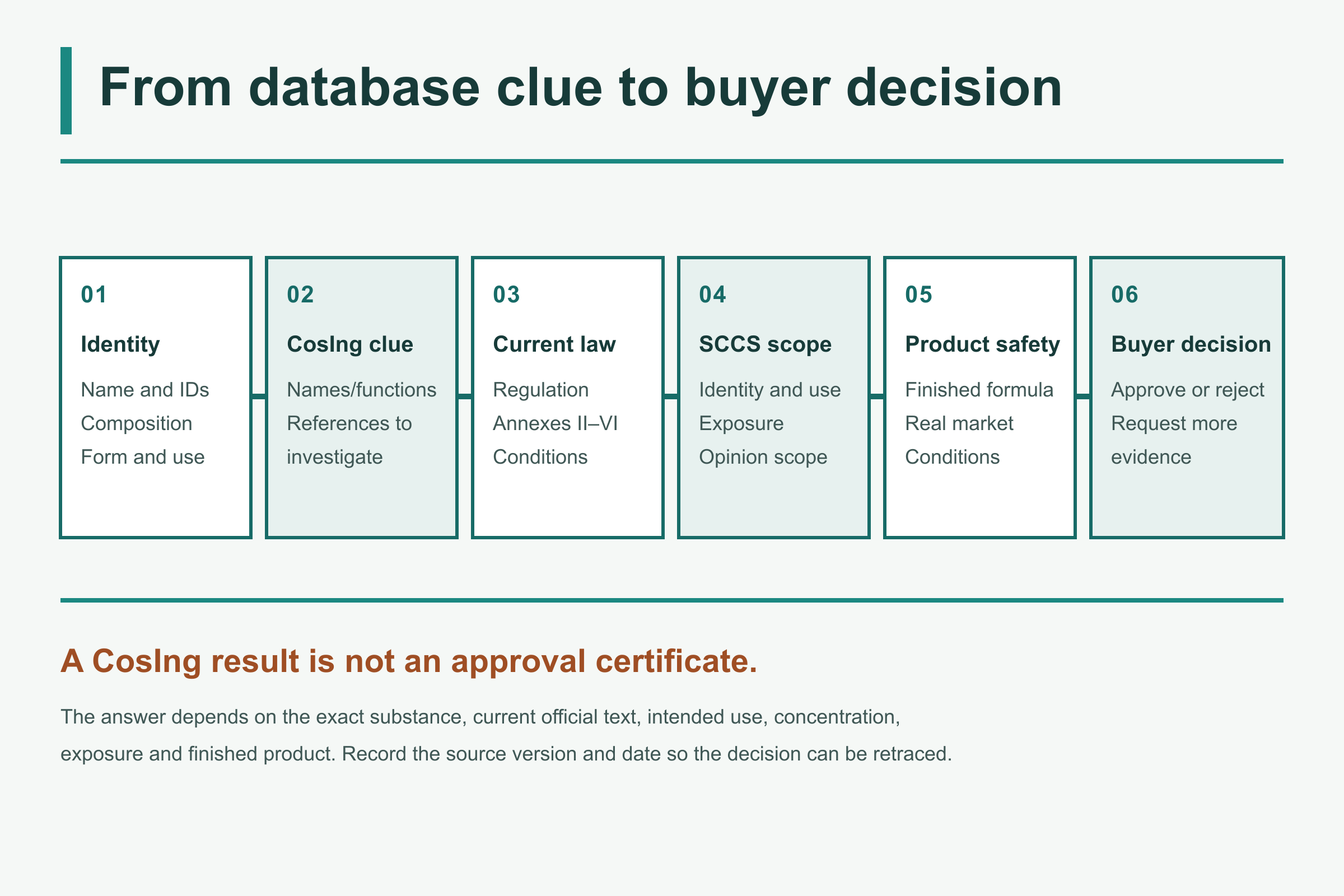
A supplier sends a screenshot and says an ingredient is “in CosIng.” That is useful information, but it is not the end of the review—and it is definitely not an approval certificate.
CosIng can help you connect a name with identifiers, reported cosmetic functions, references to the EU Cosmetics Regulation and material from the Scientific Committee on Consumer Safety (SCCS). The European Commission's CosIng notice is equally clear about the limit: the database is informative and has no legal value. An INCI name appearing there does not mean the ingredient is approved for cosmetic use.
That distinction matters before a buyer compares prices, asks for samples or sends a material to a formulator. The database is a good place to pick up the trail. The legal text, the exact material on offer and the finished-product safety assessment are what carry the decision forward.
What CosIng is good for
CosIng is the European Commission's information database for cosmetic substances and ingredients. Its records draw on the Cosmetics Regulation, the earlier Cosmetics Directive, the common ingredient-name glossary and published SCCS opinions. The search accepts names and identifiers, including CAS, ELINCS and EINECS numbers.
In a sourcing review, it can help you reconcile a supplier's naming with an official record, find a referenced annex entry that needs to be read in the law and locate a scientific opinion that may be relevant to the proposed use.
It also holds historical information. The Commission describes current data as “active” and historical data as “not active.” That status is useful, but it is not a pass or fail for the material in your formulation. Save the source and date behind the field instead of copying it into a specification without context.
The ingredient-name glossary answers a narrower question about names used in cosmetic labelling. The Commission's CosIng glossary page says that the glossary is neither a list of authorized ingredients nor exhaustive. A recognized label name and permission for a particular use are not the same thing.
Start with the material on offer
Before opening the search box, make sure everyone is talking about the same material. A broad name such as “botanical extract,” or even a familiar INCI name, may not distinguish the grade, carrier or composition that is actually being sold.
Ask for the chemical and INCI names where applicable; CAS and EC identifiers where applicable; the salt, ester, isomer, hydrate or other form; and whether the material is a single substance, mixture, extract or preparation. Active content, carrier, solvent or dilution can be just as important. So can particle or nanomaterial status, grade, manufacturer product code, manufacturing site and the impurity or residual information relevant to the intended use.
A CAS number is a useful identity clue, not a complete commercial specification. It may not resolve the grade, concentration, carrier or composition of a multi-component material. The same is true of an INCI name: it belongs to cosmetic nomenclature, but it does not describe every detail a safety assessor or buyer may need.
If the SDS, TDS and specification disagree about form or concentration, stop and reconcile that first. A precise database match for the wrong material is still the wrong match.
Leave a trail another reviewer can follow
For a plausible CosIng record, save the search term and date, displayed name and identifiers, active or historical status, reported functions, referenced annex entries and any linked SCCS material. Note any disagreement with the supplier's specification, TDS, SDS or composition statement.
That record should let a colleague repeat the search without guessing what you saw. It should not turn a listed function into permission for every product type, concentration, exposure route or claim. “Active” describes the database record; it is not a finding that the supplied grade is safe or lawful in the proposed finished product.
Move from the database to the legal text
For an EU cosmetics review, read the current official text of Regulation (EC) No 1223/2009 and the acts that amend it. On 22 August 2026, EUR-Lex identified its current consolidated version as 1 May 2026. EUR-Lex also warns that consolidated texts are documentation tools without legal effect, so a regulatory reviewer should follow the underlying Official Journal acts and their application dates as well.
Article 14 points to the annex structure:
| Where to look | What it covers | What deserves a careful read |
|---|---|---|
| Annex II | Substances prohibited in cosmetic products | Names, salts, derivatives and group entries that may not match the preferred INCI wording |
| Annex III | Restricted substances and their conditions | Product type, body area, concentration, other conditions, warnings and application dates |
| Annex IV | Colorants permitted for that regulated function, subject to the stated conditions | Exact identity, intended function and every condition in the row |
| Annex V | Preservatives permitted for that regulated function, subject to the stated conditions | Exact identity, use and conditions rather than the presence of a name alone |
| Annex VI | UV filters permitted for that regulated function, subject to the stated conditions | The difference between having a UV-related property and use as a regulated UV filter |
Read the entire possible match, including its substance identification, CAS or EC identifiers, product type or body part, concentration where specified, other restrictions, warning language and transition dates. Check cross-references and record the version you used.
Absence from one annex is not enough to call a material approved, unrestricted or suitable. Other parts of the Cosmetics Regulation may apply, including provisions on CMR substances and nanomaterials. Other EU chemical rules or the legal classification of the finished product may also matter. This is where a regulatory reviewer needs the real material and the real proposed use, not just a database name.
Read an SCCS opinion in context
The Scientific Committee on Consumer Safety publishes opinions on health and safety risks from non-food consumer products, including cosmetics and their ingredients. An opinion can be important scientific evidence, but it is not legislation.
Read the question the Committee was asked, the exact identity, product categories, concentrations, exposure assumptions, qualifications, conclusion, adoption date and any corrigendum. A sentence lifted out of that scope can sound much broader than the opinion actually is.
The Commission may use SCCS work when it adapts the annexes. The conditions in force are found in adopted legislation, not in a seller's paraphrase of an opinion. A favorable conclusion for one defined use is not blanket approval for every grade, impurity profile, concentration or application.
The Commission's SCCS Notes of Guidance, 12th revision includes two corrigenda adopted in 2023. It is detailed guidance for safety evaluation, not a database pass/fail shortcut.
Safety is assessed on the finished product
Ingredient sourcing supplies part of the evidence; it does not complete the compliance work. Article 3 of the Cosmetics Regulation requires a cosmetic product made available on the market to be safe for human health under normal or reasonably foreseeable conditions of use. Under Article 10, the responsible person must ensure that the product undergoes a safety assessment before it is placed on the market and that a cosmetic product safety report is prepared in accordance with Annex I.
The assessment takes the intended use and anticipated systemic exposure to individual ingredients in the final formulation into account. Part B must be carried out by a person with the qualifications described in Article 10. Article 11 requires the responsible person to keep the product information file, which includes the safety report and other product information.
This is why a statement such as “compliant at 2%” is not useful without context. Product type, intended function, body area, rinse-off or leave-on exposure, target users, concentration, impurities, packaging and combined exposure can all affect the review. Even where an annex gives a limit, meeting that one figure does not complete the finished-product safety assessment.
Ask the supplier for a traceable file
A useful supplier pack identifies the exact product code, manufacturer and site; names and identifiers; form and composition; and active content, carrier and relevant impurities. It should include the current specification, TDS, applicable SDS and a representative COA. Depending on the material and use, the buyer may also need manufacturing-route or origin information and defined change-notification terms.
If the supplier provides a regulatory statement, look for a date, a clearly defined scope and citations to current official sources. “Listed in CosIng” is a database observation. “Approved by CosIng” is not a sound regulatory conclusion.
Derreva's cosmetic ingredient sourcing page and cosmetics raw-material collection can help a buyer form an initial shortlist. The sourcing and document support page explains how specification, COA, SDS and TDS requests can be coordinated. None of those category or service pages changes the need to verify the exact material and evidence package.
Make the buying brief specific before requesting a quote
The buyer's file should say exactly which material, form, grade, manufacturer and site are proposed, and which cosmetic product, function, concentration and EU market are being considered. It should record the CosIng search, the current Regulation provisions and annex entries checked, and whether any SCCS opinion truly matches the identity and use.
It should also show which supplier documents are available, what the safety assessor still needs, who will act as the EU responsible person and who will perform the qualified finished-product safety assessment. Someone must own the final check for amendments, transition dates and supplier changes before purchase and again before market placement.
Finding no CosIng result does not automatically mean an ingredient is banned; the identity, synonyms and current law still need to be checked. Finding a result does not make the ingredient approved. The useful outcome of the search is a better-documented question for the people responsible for the legal and safety review.
Official sources
- European Commission: Cosmetic Ingredient Database and Important Notice
- European Commission: CosIng Glossary of Ingredients
- EUR-Lex: Regulation (EC) No 1223/2009, consolidated text dated 1 May 2026
- European Commission: Scientific Committee on Consumer Safety
- European Commission SCCS: Notes of Guidance, 12th revision
This article is educational procurement guidance, not a legal opinion or a decision on any ingredient or finished product. EU requirements change. Check the official texts and obtain qualified regulatory and safety review for the actual material, formulation and target market.